

In this article
- What is joint hypermobility?
- What are common signs of hypermobility?
- How is hypermobility checked? The Beighton score
- What is EDS and hEDS?
- Why can hypermobile joints become painful?
- How can physiotherapy help with EDS and hypermobility?
- When should you seek help?
- EDS and hypermobility physio in Auckland
- Sources
Have you always been unusually flexible? Do your joints move further than other people's, feel unstable, or sometimes cause pain? Do you experience frequent sprains, joint injuries, muscle pain or fatigue after everyday activities or exercise?
You may be wondering whether you are simply flexible or whether your symptoms could be related to joint hypermobility, Hypermobility Spectrum Disorder (HSD), or Ehlers-Danlos syndrome (EDS) — particularly hypermobile Ehlers-Danlos syndrome (hEDS).
At AZ Physiotherapy Limited in Auckland, we help people with hypermobility and EDS-related musculoskeletal problems understand their symptoms and work towards improving strength, joint control, stability and function.
What is joint hypermobility?
Joint hypermobility means that some or many of your joints can move through a greater range of motion than is typical.
Some people are naturally very flexible and have no pain or problems. Being hypermobile does not automatically mean that you have EDS or hEDS. However, when excessive joint movement is associated with ongoing pain, instability, repeated injuries or difficulties with everyday activities, further assessment may be helpful.
What are common signs of hypermobility?
People with symptomatic hypermobility may experience different combinations of symptoms. Some common signs include:
- Being able to bend your fingers, elbows or knees further than most people
- Knees or elbows that appear to "bend backwards"
- Frequently overstretching or "locking" your joints
- Joints feeling unstable or weak
- Recurrent ankle sprains or other joint injuries
- Frequent muscle strains
- Shoulder, hip, knee or ankle instability
- Joint or muscle pain without an obvious injury
- Pain after exercise or prolonged activity
- Feeling that a joint may "slip" or move out of position
- Poor balance or difficulty controlling certain movements
- Muscle fatigue when trying to maintain a position
- Difficulty returning to exercise because symptoms keep coming back
Having these symptoms does not automatically mean you have EDS or hEDS. Similar symptoms can occur for many different reasons, which is why an appropriate clinical assessment is important.
How is hypermobility checked? The Beighton score
A healthcare professional may use the Beighton score as part of an assessment of generalised joint hypermobility. It has a maximum score of 9 points and looks at specific movements involving the fingers, thumbs, elbows, knees and spine.
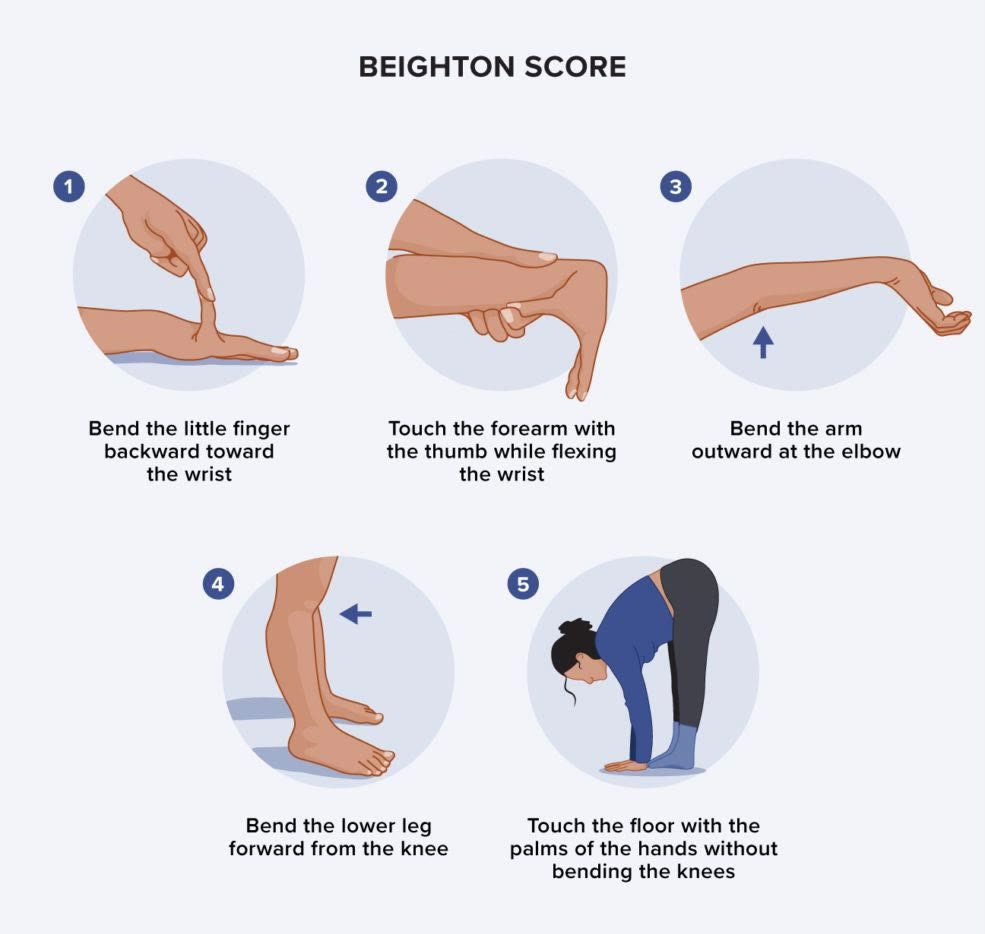
| Assessment area | Movement assessed | Points |
|---|---|---|
| Little fingers | Bending back beyond 90° (each side) | 2 |
| Thumbs | Touching the forearm with the thumb (each side) | 2 |
| Elbows | Hyperextending beyond the usual range (each side) | 2 |
| Knees | Hyperextending beyond the usual range (each side) | 2 |
| Spine | Palms flat on the floor with knees straight | 1 |
| Total | 9 |
A high Beighton score can indicate generalised joint hypermobility, but it does not by itself diagnose hEDS or EDS. It is only one part of the overall assessment — your symptoms, medical history, family history and other clinical features all matter.
What is EDS and hEDS?
Ehlers-Danlos syndromes (EDS) are a group of connective-tissue disorders. There are 13 recognised types of EDS, and their features can vary.
One type is hypermobile Ehlers-Danlos syndrome (hEDS). People with hEDS may experience generalised joint hypermobility, joint instability, chronic musculoskeletal pain and other connective-tissue-related features.
It is important to understand that hypermobility and hEDS are not the same thing. A person can be hypermobile without having EDS.
There is also currently no single blood test or genetic test that confirms hEDS. Diagnosis is based on clinical assessment and established diagnostic criteria (the 2017 international criteria), while other possible causes of the person's symptoms are considered. In New Zealand, the NZ Hypermobility and Ehlers-Danlos Syndromes Guideline gives clinicians a shared framework.
If you think you may have EDS or hEDS, a medical professional such as your GP can help determine whether further assessment is appropriate.
Why can hypermobile joints become painful?
Being flexible is not necessarily a problem. The difficulty can occur when a joint has a large range of movement but does not have enough strength, muscular control or stability to manage that movement effectively.
For example, a person may have a very mobile shoulder but struggle to control the shoulder during lifting or repetitive activities. Similarly, someone with hypermobile knees or ankles may experience discomfort, instability or repeated injuries during running or sport.
This is why physiotherapy for hypermobility is generally not about simply reducing flexibility. Instead, treatment often focuses on improving strength, stability, coordination and control.
How can physiotherapy help with EDS and hypermobility?
At AZ Physiotherapy Limited, our EDS and hypermobility physiotherapy is focused on helping you understand and manage your symptoms. Your programme may include:
- Strengthening — progressive strengthening to help the muscles support and control hypermobile joints, including the spine and core, hips and pelvis, shoulders, knees and ankles.
- Joint stability and control — improving how you control your joints during everyday activities, exercise and sport, rather than relying on passive joint structures.
- Balance and proprioception — exercises to improve body awareness and control for people who find it hard to sense where their joints are.
- Gradual exercise progression — building strength and capacity while monitoring your response, because doing too much too quickly can increase symptoms.
- Education and self-management — activity modification, exercise progression, joint protection and strategies for managing flare-ups.
For a closer look at the exercises and day-to-day strategies involved, read our guide to living with hypermobility: exercises and physio.
When should you seek help?
Consider discussing your symptoms with a healthcare professional if you regularly experience:
- Recurrent joint injuries or sprains
- Persistent or recurring joint pain
- Joint instability
- Significant flexibility combined with pain
- Difficulty exercising because of joint symptoms
- Repeated muscle strains
- Difficulty returning to sport
- Symptoms that keep returning despite rest
You do not need to have a confirmed EDS or hEDS diagnosis before seeking physiotherapy for symptoms associated with hypermobility — and you don't need a GP referral to book with us.
EDS and hypermobility physio in Auckland
Whether you have already been diagnosed with Ehlers-Danlos syndrome, have been told that you are hypermobile, or simply experience symptoms that make you question whether your joints are unusually flexible, we can assess your musculoskeletal presentation and discuss appropriate physiotherapy management. We see patients at our clinic in Pakuranga, East Auckland.
You do not have to simply live with recurring pain or unstable joints. Book an assessment, check our fees, or get in touch with questions.
Sources
- Healthify (NZ): Ehlers-Danlos syndrome (EDS)
- Ehlers-Danlos Syndromes Aotearoa NZ: NZ Hypermobility and EDS Guideline 2019
- The Ehlers-Danlos Society: 2017 international classification
Frequently asked questions
How do I know if I'm hypermobile?
What is a normal Beighton score?
What's the difference between hypermobility and hEDS?
Is there a test for hEDS?
Can physiotherapy help hypermobility?

Written by
Abdullah Abdullah — Physiotherapist & Founder, AZ Physiotherapy Limited
Abdullah Abdullah is a New Zealand-registered physiotherapist and Founder of AZ Physiotherapy Limited, with clinical experience across New Zealand and the UK. He holds a Master’s in Contemporary Musculoskeletal Physiotherapy from the University of Lincoln, UK. Meet Abdullah
This article is general information and isn’t a substitute for an individual assessment. If you have severe, worsening or unusual symptoms, seek medical advice promptly.